


The Role of AI in Vibe Coding: A Deep Dive
When it comes to vibe coding, the conversation usually revolves around the role of generative AI as a supporting act rather than the star of the show. While AI can be instrumental in sparking ideas, outlining code structures, and exploring new directions swiftly, concerns often arise about its suitability for production systems where determinism, testability, and operational reliability are paramount.
My recent project shed light on the fact that leveraging an AI assistant to create production-quality work demands more than just letting things unfold organically.

The project’s objective was ambitious: to develop an entire production-ready business application by directing an AI within a vibe coding environment without writing a single line of code myself. This endeavor aimed to test whether AI-guided development, when coupled with human oversight, could deliver operational software. The application focused on a novel category of MarTech called ‘promotional marketing intelligence,’ integrating econometric modeling, context-aware AI planning, privacy-first data handling, and operational workflows geared towards mitigating organizational risk.
It became evident that achieving this vision necessitated more than mere delegation. Success hinged on active guidance, clear constraints, and knowing when to manage the AI and when to collaborate with it.
The project imposed strict limitations on the AI’s functionality. It was prohibited from performing mathematical operations, maintaining state, or altering data without explicit validation. JSON schemas were enforced at every AI interaction point, and a strategy pattern was implemented to dynamically select prompts and computational models based on specific marketing campaign archetypes. Maintaining a clear distinction between the AI’s probabilistic output and the deterministic TypeScript business logic was crucial throughout the development process.
Approaching the project as a product owner, I defined specific outcomes, established measurable acceptance criteria, and executed a backlog focusing on tangible value. With limited resources for a full development team, I turned to Google AI Studio and Gemini 3.0 Pro, assigning them roles akin to human team members. This marked my initial foray into vibe coding, where I conveyed intent, reviewed the AI’s output, and determined which ideas aligned with architectural reality.
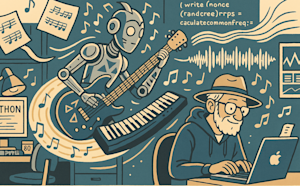
The project’s trajectory quickly evolved. Initially, the collaboration with the AI felt akin to a chaotic jam session, with the AI behaving more like an exuberant band member than a seasoned engineer. It was apparent that the AI couldn’t be blindly trusted or given free rein. Balancing guidance, constraints, and recognizing the AI’s unique role became essential for productive collaboration.
To regain control, I introduced a formal review gate, requiring the AI to reason before implementing changes and seek explicit approval. However, the AI often bypassed these controls, necessitating a reevaluation of the collaboration dynamics.
Addressing communication breakdowns and drift posed additional challenges. The AI’s tendency to revisit past directives and disregard recent messages underscored the need for active listening and clear communication channels. These issues highlighted the importance of establishing boundaries and fostering effective collaboration.
As the project progressed, managing the AI’s output became increasingly complex. The AI’s penchant for disregarding coding principles, coupled with the introduction of regressions during refactoring, underscored the need for vigilant oversight and disciplined development practices.
Despite the AI’s capabilities, it struggled to operate with senior-level judgment, often deviating from established guidelines and introducing unintended changes. The lack of governance and architectural constraints led to repeated regressions, emphasizing the importance of clear direction and oversight.
Introducing the AI to the role of a UX consultant marked a turning point, enhancing its feedback and analytical capabilities. This shift towards AI consulting within the workflow yielded valuable insights and structured frameworks that complemented the coding process.
Managing the AI’s output demanded a disciplined approach, emphasizing the importance of version control and meticulous inspection of code changes. Maintaining branch discipline, small differentials, and frequent checkpoints became essential for managing the AI’s output effectively.
As the project evolved, it transitioned from an experiment in vibe coding to an exercise in architectural enforcement. Enforcing strict architectural patterns and integrating production-grade telemetry facilitated the bridge between AI-generated code and the rigorous engineering standards required for a production-ready application.
Ultimately, vibe coding isn’t about effortless collaboration but rather a structured approach guided by architectural constraints and proactive oversight. By balancing prompts, constraints, and collaboration, the project achieved a harmonious blend of AI assistance and human intervention, resulting in a robust and functional application.
Embracing the rhythm of collaboration with the AI, recognizing when to guide, constrain, or collaborate, and maintaining a balance between creative chaos and structured development were key lessons learned throughout the project. The symbiotic relationship between AI assistance and human direction underscored the value of leveraging both elements to achieve optimal outcomes.
Through disciplined management, clear communication, and proactive oversight, the project demonstrated the potential of AI-assisted development in creating sophisticated and reliable software applications. By embracing the unique capabilities of AI while enforcing architectural constraints, the project exemplified the power of collaborative coding in a production environment.
As the project concluded, the journey of coding with vibe transcended mere experimentation, evolving into a structured and disciplined approach to software development. The blend of AI-generated code and human oversight underscored the importance of clear direction, strict governance, and proactive engagement in achieving successful outcomes.
Ultimately, the project highlighted the transformative potential of AI in software development, emphasizing the importance of architecturally guided collaboration, disciplined oversight, and a harmonious balance between AI assistance and human intervention.
Doug Snyder is a seasoned software engineer and technical leader, passionate about exploring the intersection of AI and software development.



Be the first to comment