



The declining momentum in the cryptocurrency market, combined with ongoing geopolitical tensions, is causing Bitcoin’s price to decrease. The decrease in BTC’s price and sentiment indicates a period of uncertainty and caution as investors seek alternative assets to hedge against geopolitical risks.
Bitcoin’s Decline Reflects Broader Risk-Off Movement
Bitcoin continues to trend downward as its price remains below $70,000, influenced by global geopolitical tensions. The market is at a critical juncture where bearish action could potentially reverse or persist.

Walter Bloomberg noted that Bitcoin is sliding due to geopolitical risks prompting risk-off trading, as seen in the correlation between the cryptocurrency’s price and Nasdaq Futures. This synchronized decline suggests that macro factors like changing interest rate expectations and a general sense of risk aversion are driving market behavior across asset classes.
Reports indicate that Bitcoin dropped by 1.7% to around $67,000 before the US market opened, following weaker equity futures. Meanwhile, Nasdaq 100 Futures and S&P 500 contracts also experienced declines.
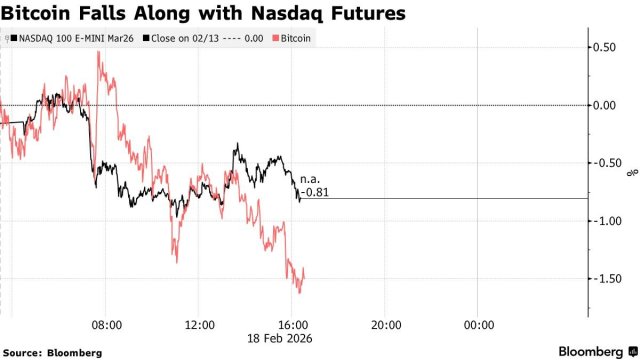
This development has impacted investor sentiment and focus. Investors are exercising caution due to escalating tensions with Iran, discussions on AI’s broader economic impacts, and uncertainty surrounding a potential Fed rate cut following recent inflation data.
Amidst geopolitical tensions, there have been negative flows, particularly from Exchange-Traded Funds (ETFs). US-listed Bitcoin ETFs saw a fourth consecutive week of outflows, with over $360 million withdrawn just last week. These outflows indicate a weakening sentiment, as reflected in CryptoQuant’s Fear and Greed Index, currently at 10, classified as extreme fear.
While the market sentiment has reached extreme fear levels, analysts anticipate that BTC may prolong its consolidation phase, with $60,000 serving as crucial support. However, further macroeconomic shocks could drive BTC’s price towards the $50,000 threshold.
Identifying Stressed BTC Investors
During periods of increased bearish sentiment, analyzing investors’ behavior is vital in understanding the current market conditions and potential future direction. In a recent study, Anil, an on-chain researcher and investor, highlighted a significant divergence between Bitcoin’s short-term and long-term holders.
In the current market environment, short-term BTC holders are experiencing stress due to capitulation, while long-term holders have not yet faced significant stress or capitulation.
It is important to note that long-term holders typically go through a phase of capitulation in each cycle, followed by a new uptrend after an accumulation period. However, it is uncertain whether this group will undergo capitulation again this time. If it does, Anil suggests that the area below 1 on the LTH Unrealized Profit/Loss Ratio chart would be a critical juncture for the market.
Featured image from Pixabay, chart from Tradingview.com

bitcoinist’s Editorial Process focuses on delivering thoroughly researched, accurate, and unbiased content. We adhere to strict sourcing standards, with each page undergoing thorough review by our team of top technology experts and seasoned editors. This process ensures the integrity, relevance, and value of our content for our readers.



Be the first to comment