



The Impact of AI on Bitcoin Mining Industry Revealed in Coinshares Report
A recent analysis of bitcoin mining has shown that the fourth quarter of 2025 presented significant challenges for miners, with the price of bitcoin dropping from $124,500 in October to $86,000 by December. Despite this price decline, network hashrate remained high, leading to decreased profitability. The cost to produce one bitcoin rose to almost $80,000, resulting in many operators operating at breakeven levels.
In Q4, hashprice, a key revenue metric, fell to $36 to $38 per petahash per second (PH/s) per day, and further dropped to around $29 in early 2026. These conditions led to signs of miner capitulation, including three consecutive negative difficulty adjustments for the first time since July 2022.

According to James Butterfill, head of research at Coinshares, this challenging environment for miners is a result of price pressure and increased network competition since the last halving.
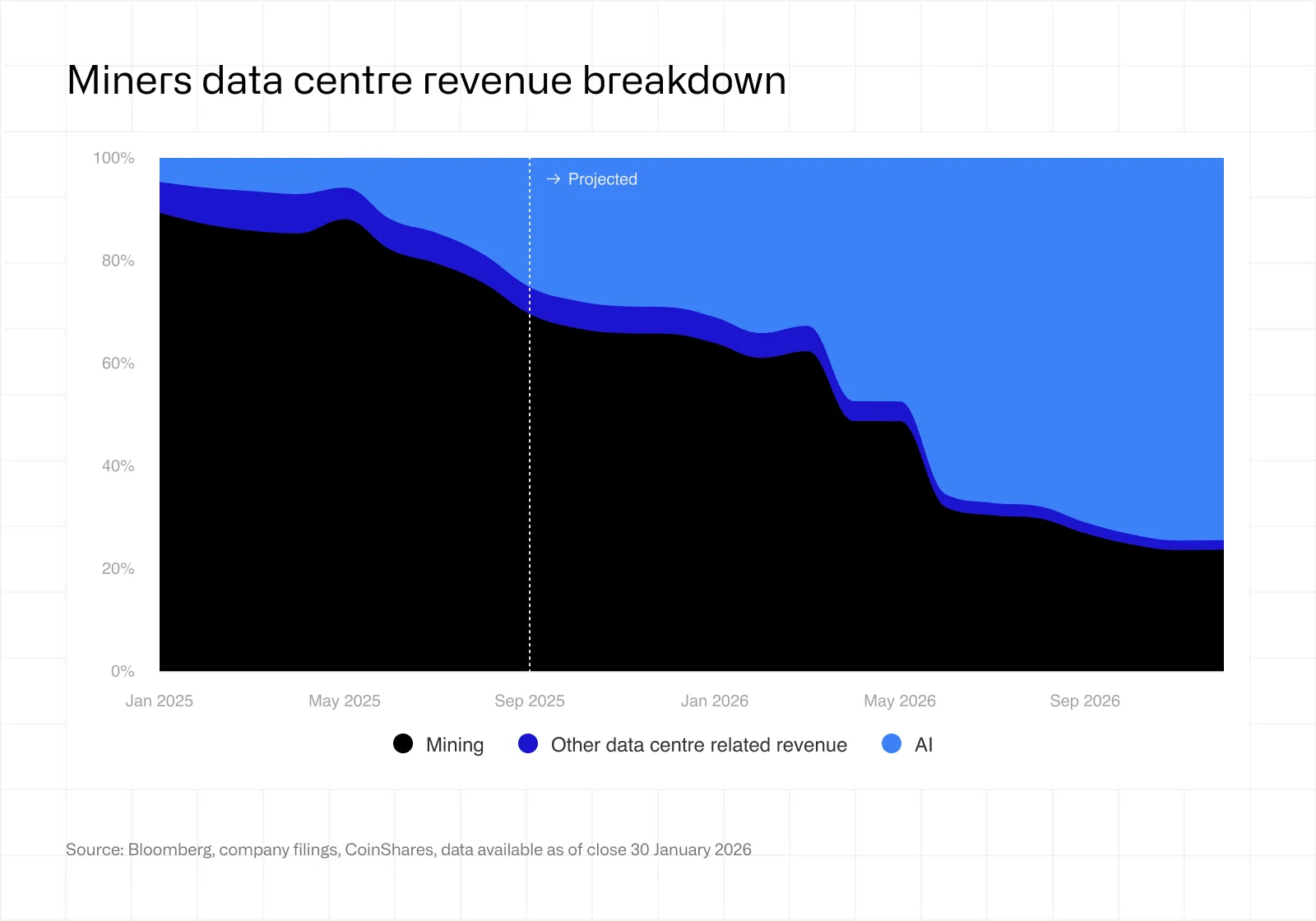
In response to these challenges, the industry is turning to AI and high-performance computing (HPC) as an alternative revenue source. Publicly listed miners have announced over $70 billion in AI and HPC-related contracts, with some companies expected to generate up to 70% of revenue from AI by the end of 2026.
This shift reflects a trade-off between AI infrastructure and bitcoin mining, with AI offering more stable returns under current conditions. However, the transition is not uniform, with some companies focusing on data center operations while others maintain a balance between mining and AI strategies.
Despite recent volatility, the Bitcoin network remains robust, with hashrate stabilizing around 1,020 exahash per second. Coinshares predicts continued growth, with hashrate expected to reach 1.8 zettahash by the end of 2026 and 2 zettahash by early 2027.
Geographically, the United States, China, and Russia continue to dominate global mining, accounting for 68% of total hashrate, while countries like Paraguay and Ethiopia are making strides in the industry.
While miners are shifting towards AI, the economics of mining are still tied to bitcoin’s price. Higher prices could improve margins, while prolonged weakness may force more operators offline. The industry is evolving into two categories: traditional miners and hybrid firms balancing bitcoin production with AI-driven activities.
Frequently Asked Questions 🧭
Why are bitcoin miners facing challenges in 2026? Lower bitcoin prices and increased hashrate have squeezed margins and pushed costs close to breakeven.
What is hash price and why is it important? Hash price measures miner revenue per unit of computing power and directly affects profitability.
Why are miners transitioning to AI? AI infrastructure offers more consistent returns compared to current mining conditions.
Will bitcoin mining bounce back? Profitability is closely tied to bitcoin’s price, with higher prices expected to improve margins.



Be the first to comment