

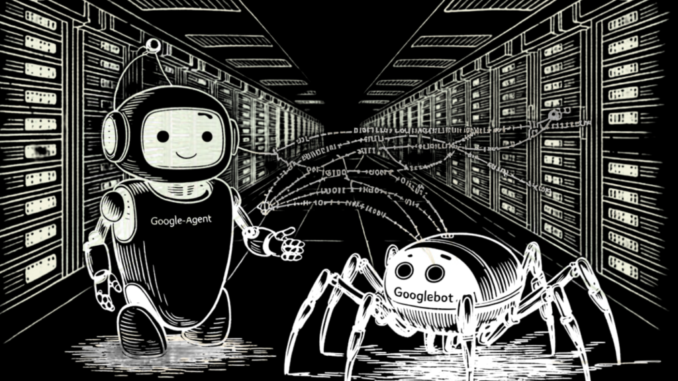

Google has recently introduced a new technical entity called Google-Agent, which has been appearing in server logs as the company integrates AI capabilities across its product suite. For software developers, understanding Google-Agent is crucial as it helps differentiate between automated indexers and real-time user-initiated requests.
Unlike the traditional autonomous crawlers that have been prevalent on the web for years, Google-Agent operates under a different set of rules and protocols.
Key Difference: Fetchers vs. Crawlers
The primary technical distinction between Google’s legacy bots and Google-Agent lies in the trigger mechanism.
Autonomous Crawlers (e.g., Googlebot): These bots find and index pages based on a schedule set by Google’s algorithms to keep the Search index updated.
User-Triggered Fetchers (e.g., Google-Agent): These tools only act when a user initiates a specific action. According to Google’s developer documentation, Google-Agent is used by Google AI products to fetch content from the web in response to direct user prompts.

Unlike traditional crawlers that explore the web by following links to discover new content, these fetchers are reactive and act as a proxy for the user, retrieving specific URLs as requested.
Exception with Robots.txt
One significant technical detail about Google-Agent is its relationship with robots.txt. While autonomous crawlers like Googlebot adhere strictly to robots.txt directives to determine which parts of a site to index, user-triggered fetchers usually operate under a different protocol.
According to Google’s documentation, user-triggered fetchers ignore robots.txt directives.
This deviation is due to the nature of the agent acting as a ‘proxy.’ Since the fetch is initiated by a human user requesting to interact with specific content, the fetcher behaves more like a standard web browser than a search crawler. If a site owner blocks Google-Agent via robots.txt, the instruction is typically disregarded because the request is considered a manual action on behalf of the user rather than an automated data collection effort.
Recognition and User-Agent Strings
Developers need to accurately identify this traffic to avoid it being mistaken for malicious or unauthorized scraping. Google-Agent identifies itself through specific User-Agent strings.
The primary User-Agent string for this fetcher is:
Mozilla/5.0 (Linux; Android 6.0.1; Nexus 5X Build/MMB29P)
AppleWebKit/537.36 (KHTML, like Gecko) Chrome/W.X.Y.Z Mobile
Safari/537.36 (compatible; Google-Agent)
Sometimes, a simplified token like Google-Agent is also used.
For security and monitoring purposes, it’s essential to note that since these fetchers are user-triggered, they may not originate from the same predictable IP blocks as Google’s main search crawlers. Google recommends using their published JSON IP ranges to verify the legitimacy of requests made under this User-Agent.
Importance for Developers
For software engineers managing web infrastructure, the emergence of Google-Agent shifts the focus from SEO-centric ‘crawl budgets’ to real-time request management.
Observability: It’s crucial for modern log parsing to treat Google-Agent as a legitimate user-driven request. If your WAF (Web Application Firewall) or rate-limiting software treats all ‘bots’ the same, you might unintentionally block users from utilizing Google’s AI tools to interact with your site.
Privacy and Access: With Google-Agent not following robots.txt directives, developers cannot rely on it to conceal sensitive or non-public data from AI fetchers. Access control for these fetchers must be managed through standard authentication or server-side permissions, similar to handling human visitors.
Infrastructure Load: The traffic volume of Google-Agent is tied to human usage patterns, making it ‘bursty’ and scaling with the popularity of your content among AI users. This is in contrast to the frequency-based scaling of Google’s indexing cycles.
Conclusion
Google-Agent signifies a shift in how Google interacts with the web by transitioning from autonomous crawling to user-triggered fetching. This change establishes a more direct connection between the user’s intent and live web content. The key takeaway is that traditional protocols like robots.txt are no longer the primary tool for managing AI interactions. Accurate identification using User-Agent strings and a clear grasp of the ‘user-triggered’ concept are now essential for maintaining a modern web presence.
Explore the Google Docs here. Additionally, feel free to follow us on Twitter and make sure to join our 120k+ ML SubReddit and subscribe to our Newsletter. Are you on telegram? You can now join us on telegram too.
Michal Sutter is a data science professional with a Master of Science in Data Science from the University of Padova. With a solid foundation in statistical analysis, machine learning, and data engineering, Michal excels at transforming complex datasets into actionable insights.



Be the first to comment