
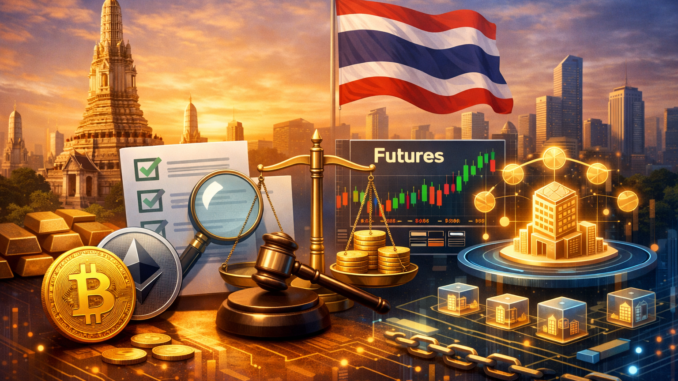

Thailand’s Securities and Exchange Commission is in the process of developing new regulations to integrate crypto investment products more deeply into the formal financial system of the country.
The SEC is currently drafting guidelines to support the trading of crypto exchange-traded funds (ETFs), crypto futures, and tokenised investment products, as per SEC deputy secretary-general Jomkwan Kongsakul.
According to a report by the Bangkok Post, the SEC plans to release official guidelines for crypto ETFs in Thailand at the beginning of this year.
This move indicates Thailand’s desire to establish itself as a prominent crypto hub for institutional investors in the region, despite the ongoing ban on crypto payments.
Advancement of Crypto ETFs Towards Formal Approval
Kongsakul mentioned that the SEC’s board has provisionally approved crypto ETFs, with the agency currently finalising the investment and operational regulations. He highlighted that crypto ETFs could potentially lower barriers for investors who are hesitant to directly hold digital assets.
He further added, “One of the main advantages of crypto ETFs is their accessibility; they address concerns regarding hacking and wallet security, which have been significant barriers for many investors.”
Under the proposed framework, the SEC will categorise crypto as “another asset class,” allowing investors to allocate up to 5% of a diversified portfolio to digital assets.
Introduction of Futures Trading on TFEX
In addition to ETF guidelines, the SEC is also working towards regulating and facilitating crypto futures trading on the Thailand Futures Exchange (TFEX).
This move will enable investors to participate in crypto price movements through regulated derivatives markets.
Kongsakul highlighted other initiatives under consideration, such as establishing market makers to enhance trading liquidity and officially recognising digital assets as an asset class under the Derivatives Act.
Thailand has been actively seeking to attract more institutional interest in crypto markets, particularly through regulated products that align with existing legal frameworks.
Tokenisation and Collaboration with Central Bank for Sandbox Testing
The SEC is expanding its focus beyond ETFs and futures with tokenisation initiatives.
Kongsakul mentioned that the agency is collaborating with the Bank of Thailand on a tokenisation sandbox, which could serve as a controlled environment for testing tokenised instruments.
He added, “The SEC will encourage issuers of bond tokens to participate in the regulatory sandbox.”
By introducing tokenised bond products into a supervised environment, Thailand aims to establish regulated pathways for blockchain-based issuance without compromising on monitoring retail distribution.
Enhanced Oversight for Financial Influencers
While expanding product offerings and market access, the SEC is intensifying regulations concerning online promotion and investment-related content.
Kongsakul mentioned that the regulator is ramping up supervision of “financial influencers,” indicating stricter controls on marketing and informal advisory activities.
He stated, “Any recommendations related to securities or investment returns will require proper authorization as either an investment advisor or introducing broker.”
The regulations aim to curb unregulated investment promotion, especially amidst the widespread discussion of digital assets on social media platforms.
Efforts to Resolve SEC Suspension by KuCoin Thailand
The regulatory developments coincide with the Thai SEC’s continued enforcement actions within the local exchange market.
Earlier in January, the SEC suspended operations of KuCoin Thailand due to the company’s capital falling below the minimum requirements for five consecutive days, as reported by local news outlet The Nation.
KuCoin Thailand attributed the breach to a shareholder dispute between Singapore’s CI group and KuCoin Global, which hindered the approval of a planned capital increase.
The company clarified that the issue did not stem from actual financial liquidity challenges.
Having entered the Thai market in June 2025, KuCoin is in the process of applying for a digital-asset broker license for its local entity.
This move is aimed at broadening the range of financial products offered by the company.
Despite the ban on crypto payments, Thailand’s crypto market remains active, with Bitkub, the country’s largest exchange, witnessing daily trading volumes of approximately $60 million.
Regulators appear to be prioritising structured investment access through products like ETFs, futures, and tokenised instruments, in a bid to ensure controlled and regulated market participation.



Be the first to comment