


Record Bitcoin Sales by Public Miners Set Industry Milestone
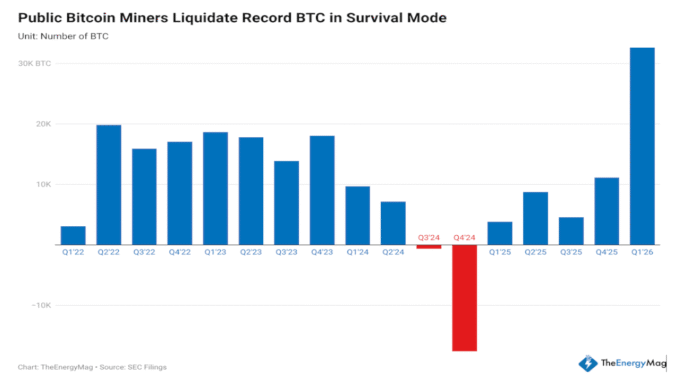
The latest report from Miner Weekly, a newsletter by BlocksBridge Consulting, highlights the significant milestone achieved by several major public miners in the first quarter of 2026. Companies such as MARA, CleanSpark, Riot, Cango, Core Scientific (NASDAQ: CORZ), and Bitdeer (NASDAQ: BTDR) collectively sold over 32,000 BTC during this period, marking a record-breaking achievement in the industry.
This data, analyzed by TheEnergyMag, indicates a substantial increase in sales compared to the total net sales across all four quarters of 2025. The current figure surpasses the approximately 20,000 BTC liquidated by public miners in the second quarter of 2022 during the market turbulence caused by the Terra-Luna collapse.

The shift in selling behavior is noteworthy considering that just a year ago, miners were actively accumulating BTC, ending 2024 with a net addition of 17,593 BTC and reaching a combined reserve of over 100,000 BTC.
The challenging market conditions can be attributed to the decline in hashprice, a key metric in the industry that measures expected mining revenue per unit of computing power. With hashprice hovering around the low $30/PH/s range, margins have become compressed or negative, especially for miners operating older, less efficient equipment or facing higher power costs.
The root cause of the current pressure can be traced back to the rapid expansion of hashrate following China’s mining ban in 2021. This period of exponential growth came at the expense of individual companies, leading to the current downturn in profitability.
Industry Divergence and Strategic Shifts
Despite the uniform record of liquidation, the industry is beginning to diverge, with some operators compelled to sell assets in a weakening market while others leverage structural advantages and financial discipline to navigate the downturn.
For many miners, maintaining liquidity is a top priority. Selling BTC provides a quick solution to bolster balance sheets, support operations, and meet financial obligations in a selective and costly financing environment.
One standout example is American Bitcoin (ABTC), the proprietary mining division of Hut 8 (NASDAQ: HUT), which has adopted a strategy of accumulating BTC through mining and market purchases. As of early April, ABTC had amassed reserves exceeding 7,000 BTC, a significant increase from zero a year earlier, while scaling its proprietary hashrate to 28 EH/s.
Unlike its counterparts, ABTC is focusing on quality growth under current market conditions rather than pursuing hashrate expansion at all costs. Matt Prusak, president and interim CFO of ABTC, emphasized the company’s commitment to prudent decision-making and sustainable growth.
ABTC’s strategic acquisition of Antminer S21 series machines from Bitmain in exchange for pledged BTC demonstrates a unique approach to fleet expansion amidst market fluctuations. This unconventional deal structure underscores the company’s resilience and adaptability in challenging market conditions.
Based on Q4 2025 data, ABTC’s cash cost of production per bitcoin is among the lowest in the public mining sector, enabling the company to accumulate BTC at a discount to prevailing market prices.
Prusak reiterated ABTC’s flexibility in capital allocation, highlighting the company’s ability to mine or buy BTC based on market dynamics. With recent capital raises totaling $350 million, ABTC is well-positioned to weather market volatility and focus on long-term growth.
Private operators without similar access to capital are increasingly shaping their strategies around power costs, a fundamental variable in the industry. Sean McDonough, president and CEO of New West Data, emphasized the importance of low power costs in sustaining profitability and enabling expansion, particularly for operators utilizing innovative power sources like flared natural gas.
New West Data’s success in leveraging off-grid power generated from flared gas to mine BTC underscores the significance of operational efficiency and cost optimization in the current market environment.
Operational Optimization and Technology Adoption
Amidst market challenges, mining operators are turning to operational optimization and technology solutions to enhance efficiency and maintain profitability. Luxor, a prominent mining pool operator and ASIC broker, recently introduced the Commander platform, a fleet management tool designed to optimize power settings and improve profitability.
The shift towards software-driven solutions reflects a broader trend in the industry, where operators are prioritizing incremental efficiency gains and cost savings over large-scale hardware upgrades. Luxor’s Commander platform has demonstrated notable improvements in profitability for mining fleets by dynamically adjusting power settings based on real-time market conditions.
Ethan Vera, Luxor’s chief operating officer, highlighted the successful implementation of Commander across customer hashrate, showcasing the platform’s effectiveness in enhancing operational efficiency and profitability.
The industry’s evolution towards customized strategies and operational sophistication underscores a shift from traditional scale-driven models to a more nuanced approach focused on quality growth and sustainable profitability.
Overall, the mining sector’s resilience and adaptability in the face of market challenges reflect a maturing industry landscape characterized by strategic diversification, operational excellence, and technological innovation.
For more insights, read the original article here.



Be the first to comment