

Running advanced AI models on mobile devices presents a challenge that goes beyond hardware limitations – it also involves the architecture of the models themselves. Many cutting-edge vision encoders are large and when compressed to fit on edge devices, they lose their effectiveness. Additionally, specialized models excel in specific tasks but struggle with tasks outside their expertise.
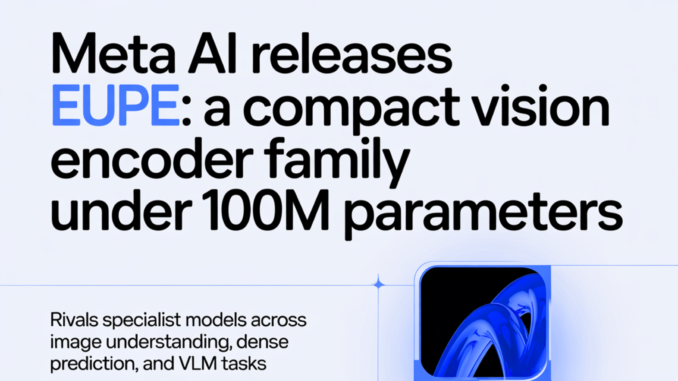
Meta’s AI research teams have introduced a new approach with the Efficient Universal Perception Encoder (EUPE): a compact vision encoder capable of handling various vision tasks simultaneously without the need for a large size.
The Core Problem: Specialists vs. Generalists
Understanding why EUPE is significant requires knowledge of how vision encoders function and the issues with specialization. A vision encoder is responsible for converting raw image pixels into a concise representation that downstream tasks can utilize. Modern vision encoders are trained with specific objectives, making them proficient in certain domains. However, deploying multiple encoders on edge devices to handle diverse tasks simultaneously is computationally intensive. As a result, a single encoder may underperform in multiple domains.
Previous Attempts: Why Agglomerative Methods Fell Short on Efficient Backbones

Researchers have attempted to combine the strengths of multiple specialist encoders using agglomerative multi-teacher distillation methods. While these methods work well for large encoders, applying them to efficient backbones leads to subpar results. The main issue is the lack of representational capacity in efficient encoders to absorb diverse feature representations from multiple teachers.
EUPE’s Answer: Scale Up First, Then Scale Down
EUPE introduces the concept of ‘first scaling up and then scaling down.’ Instead of directly distilling knowledge from multiple domain expert teachers into a small student, EUPE utilizes an intermediate model known as a proxy teacher. This proxy teacher, with sufficient capacity, unifies the knowledge from various domain experts and transfers it to the efficient student through distillation.
The full pipeline consists of three stages: multi-teacher distillation into the proxy model, fixed-resolution distillation into the efficient student, and multi-resolution finetuning. Each stage plays a crucial role in training the efficient encoder to handle diverse vision tasks.
An Important Negative Result: Not All Teachers Combine Well
The selection of teachers for the distillation process is crucial. Including certain teachers can degrade performance, as observed with SigLIP2-G alongside other domain experts. The right combination of teachers is essential for achieving optimal performance across different tasks.
What the Numbers Say
Ablation studies validate the effectiveness of the three-stage design in EUPE. Directly distilling from multiple teachers to an efficient student yields poor performance, while adding the proxy model significantly improves results. The full three-stage pipeline achieves the best balance across various vision tasks.
What the Features Actually Look Like
Qualitative feature visualization reveals the strengths and weaknesses of different encoders. While some models exhibit semantic coherence but lack spatial consistency, others have sharp features but lack fine-grained discrimination. EUPE-ViT-B combines the best qualities of all domain experts, resulting in a versatile and effective vision encoder.
A Full Family of Edge-Ready Models
EUPE offers a complete family of models under 100M parameters, spanning ViT and ConvNeXt architectures. These models are optimized for real-world edge deployment, with varying performance levels and inference latency measured on different devices.
Key Takeaways
EUPE provides a single compact vision encoder that rivals specialized models in various vision tasks. The innovative three-stage distillation pipeline and careful selection of teachers contribute to its success. EUPE is designed for practical deployment on edge devices, emphasizing data quality over quantity for model performance improvement.
Check out the Paper, Model Weight and Repo. Also, feel free to follow us on Twitter and don’t forget to join our 120k+ ML SubReddit and Subscribe to our Newsletter. Wait! are you on telegram? now you can join us on telegram as well.
Need to partner with us for promoting your GitHub Repo OR Hugging Face Page OR Product Release OR Webinar etc.? Connect with us.



Be the first to comment